Wojciech Fangor. Nudes, 1945-2010
-
Dates
November 30, 2024—March 1, 2025
Add to calendar - Venue GNYP Gallery, Berlin
External links Visit Exhibition
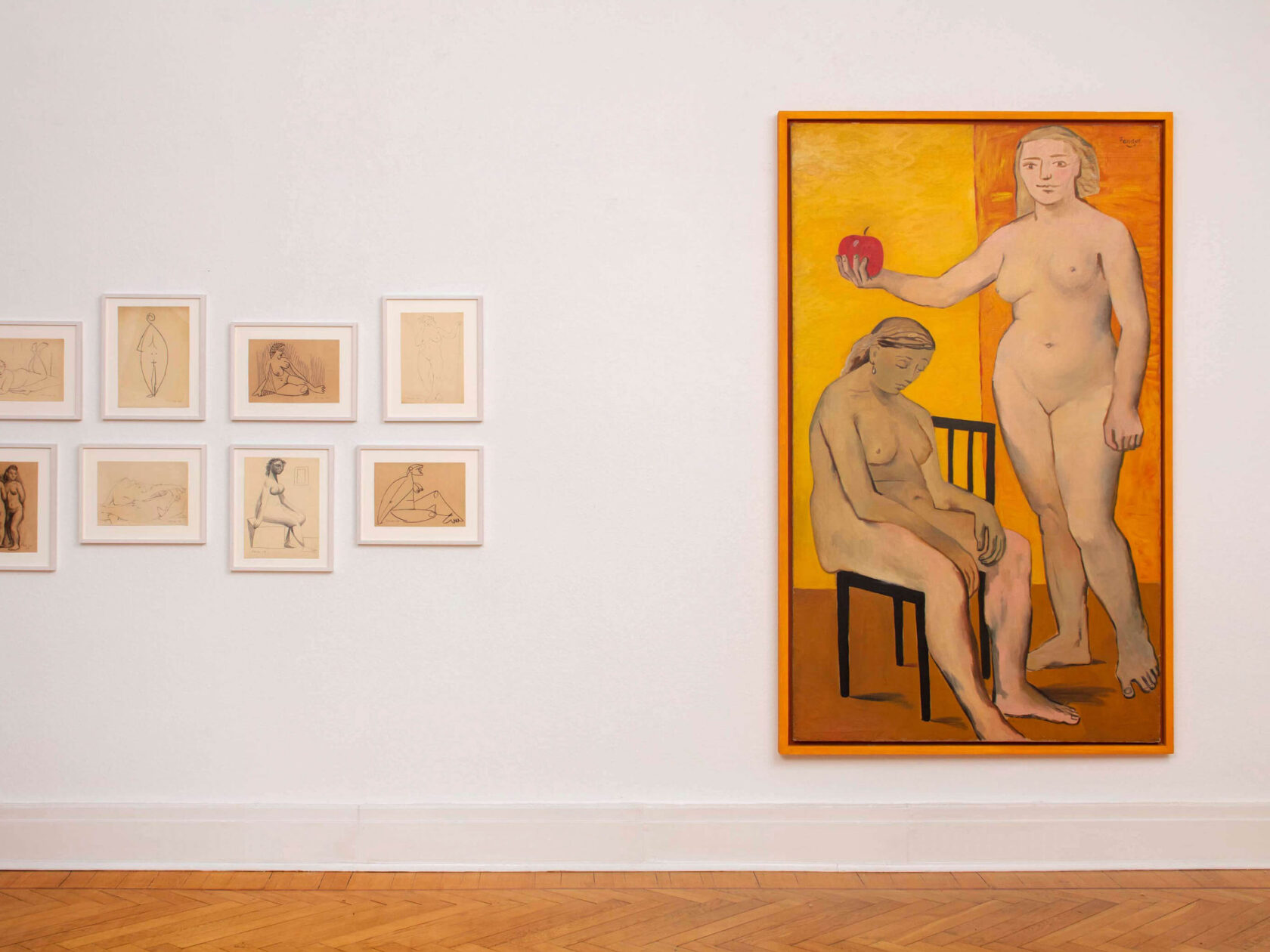
The solo exhibition Nudes is the latest in an ongoing series devoted to some of the artist’s lesser known subjects and groups of work, such as Fangor’s pulsating Television Paintings or transitional Interfaces series.
The exhibition presents a collection of rarely seen paintings and many drawings that explore the naked human form with all its variety and cultural resonances. The Nudes exhibition includes works dating from Fangor’s artistic beginnings in the turbulent and difficult late 1940s, right up until the visually effervescent and experimental large-scale partially painted collages he produced in the 21st century.
The intention of focusing on his non-canonical work is not to diminish Fangor’s significant contribution to abstraction. Instead, it is to explore his oeuvre in the spirit of the artist’s own open-mindedness. An approach that no longer needs, for instance, to be limited to notions such as the abstraction/figuration divide of the Cold War era. It also gives more attention to the radically shifting cultural-political realities the artist faced and his variegated creative response.
The motif of the exhibition suggests itself naturally, as Fangor drew and painted the human form continuously during his life. This was the case even while he was presenting his highly successful abstract work to exhibitions and for sale. By taking just a small section of his oeuvre as a case study, the implicit premise of Nudes is to consider the artist’s work as a vibrant, interwoven, contrasting, self-reflective whole. (It also draws attention to Fangor’s vulnerable, intimate side.) Instead of suggesting a heroic linear progression with a mid-point aesthetic climax, what emerges is a thoughtful and ethical artist in a long conversation about art and society.
Drawing was an essential personal and artistic activity for Fangor. Teeming with everyday and bohemian life, his nude work variously depicts intimates, friends, and other not-yet-identified models, in both academic and avant-garde styles, thus evidencing a form of ongoing artistic research. Several early sketches, each entitled Akt męski [Male Nude] (1948), show men standing and bending—the lean of their bodies perhaps suggesting some wartime depravation or physical labor. Other contemporaneous works explore Cubism (Akt kubistyczny [Cubist Nude], 1948), or a hybrid semi-abstraction like Henry Moore’s, while others still return to classicist modes such as more realistically rendered, reclining female nudes. Decades on, Fangor’s second wife, the artist and art historian Magdalena Shummer-Fangor, makes an impression of solid dependability in the charcoal sketch Dwa akty [Magda] [Two Acts, Magda] 1991. The drawing depicts her in two robust, standing, side-by-side views with a cropped head that emphasizes the weight and strength of her torso and legs. After joining Fangor in Vienna in 1961, she stayed with him for the rest of his life, and often posed for him in many moods, styles, and domestic settings.
In 2005 a tranche of early drawings was recovered, which led to the creation of this later painted collage work. In compositions such as Akt (1950-2005) and Pedicure 2 (1990-2005), Fangor dramatically and joyously reposits his own beginnings. What is unique about this series of works is their synthesis of abstraction and his life-drawings. Abstraction becomes a filter, a framing screen, or a vibrant responsive field in which the figure is immersed.
Exhibition was mounted in close cooperation with the FANGOR Foundation, which is completing the artist’s extensive Catalogue Raisonné. In the past few years, this combined activity has added to the understanding of the breadth of Fangor’s work. It has also proposed an inclusive appreciation of his experimentation across mediums and contrasting styles.